


Electric Oven Not Heating Up – What's the Cause and What to Do
 March 13, 2026
 Read 8 minutes
 March 16, 2026
Content of the Article
If you've turned on the oven, the indicators light up, the control panel responds to commands, but there's no heat. Or the heating is so weak that your pie sits for hours and still comes out raw – this article is for you.
According to statistics, such complaints make up to 30% of service calls for repairs.
In this article, we'll break down:
- What to check first,
- When to call a technician,
- How to avoid repeats.
 Call Now: (704) 430-6869
Quick Checklist – What to Check Right Away?
- Is the correct mode selected (Bake / Broil)? Make sure the heating mode matches what you need – Bake for even cooking, Broil for grilling. If the wrong one is chosen, the oven might not activate the necessary elements.
- Is the temperature set? Check if the temperature is set above room level. Sometimes the regulator gets knocked off, and the oven is just "waiting" for a command.
- Is there power (did the breaker trip)? Look in the electrical panel – the kitchen breaker might have tripped due to overload. Flip it back on and try again.
- Is the outlet working? Plug in another appliance to confirm electricity is flowing. If the outlet is faulty, the oven won't get full power.
- Is the oven door fully closed? The oven won't heat if the door is ajar. Check if it seals tightly with no gaps.
Causes You Can Check Yourself
After going through the checklist, you might discover one of the reasons why the oven isn't heating:
- Wrong mode or temperature selected
This is one of the simplest mistakes: the oven turns on, the interior light comes on, but there's no heat.
Why? In Bake mode, heating comes from bottom and top; in Broil – only from the top for browning. If Convection is selected unnecessarily or the temperature is at zero, the oven simply won't start the heating elements. You can switch the mode on the control panel yourself and set a temperature, like 350°F (180°C). If nothing changes after that, the problem is deeper. - Power supply issues
Often, the oven gets partial power: the panel lights up, but no heating. This could be due to a tripped breaker in the panel – check and reset it.
Important: It's normal if the breaker trips once from network overload, but if it keeps happening, call a technician: there might be home wiring issues. Don't ignore it to avoid fire risks. - Faulty outlet or power cord
The outlet might look fine on the outside, but contacts inside could be loose, causing weaker heating. The oven's cord might get damaged from frequent moving. You can check this without tools – plug in a hair dryer or kettle to the same outlet. If they don't work, call an electrician.
Important: Don't keep using a faulty outlet or appliance with a damaged cord – there's a risk of overheating or sparks. - Oven door not closing tightly
Modern models have sensors: if the door isn't locked, heating is blocked for safety. Even if the door is closed, the issue could be a worn seal (rubber gasket) or broken latch – the oven "thinks" it's open. Check for gaps and close it firmly again.
If the seal is deformed, it can be easily replaced, but it's better to let a technician handle it. That way, you'll be sure it's installed evenly. - Oven heats up but doesn't reach the set temperature
The dish doesn't bake evenly, or the thermometer inside shows lower than set. This could indicate worn parts.
Check if the vents are clogged, and test on a simple task, like heating water. If the problem persists, diagnostics are needed.

Appliance Repair for precise identification of the cause. We'll come at a time convenient for you or within an hour of your call.
 Call Us
Causes That Require a Technician
DIY repairs in these cases can be dangerous: electricity, high temperatures, and complex parts. Better not to risk it and call a specialist.
- Burned-out heating element (Bake / Broil element)
It shows up like this: oven turns on, but it's cold inside.
The element is a coil that heats from electricity; if it's burned out, no heat. Replacement should be done by a technician: power must be disconnected, panels removed, and a new original element installed to avoid fire risks. - Faulty thermostat or temperature sensor
The oven might overheat or not gain heat: temperature doesn't match the setting. The thermostat regulates the heating cycle, the sensor measures it.
Repair requires special tools and knowledge, or you risk making it worse. - Issue with the control board
Signs: panel flickers, modes don't switch, heating is erratic.
This is the "brain" of the oven, and an electronics glitch makes repair complex. Only a technician can accurately pinpoint the fault and fix it effectively. Sometimes parts need replacement. - Damaged internal wiring
In this case, high risk of short circuit: wires might melt from overheating. DIY intervention is dangerous – you could get shocked or the wire could ignite. A technician will safely inspect and restore insulation. - Oven heats up and then shuts off
This is a protective mechanism against overheating, but if it triggers often, the fan or thermostat is broken. Without repair, failure of these parts can lead to complete oven breakdown.
Real Repair Cases from Prime Appliance Repair
LG Oven Heating Too Slowly
The client complained that the LG oven took forever to heat up and didn't hold a stable temperature – baking didn't turn out right.
Diagnostics showed: the heating element was burned out, causing uneven heat circulation.
The technician replaced the element and tested the temperature for accuracy.
Result: The oven heats up quickly and holds heat steadily. The client could cook delicious meals again, no need to buy a new oven.
When Not to Delay Repair
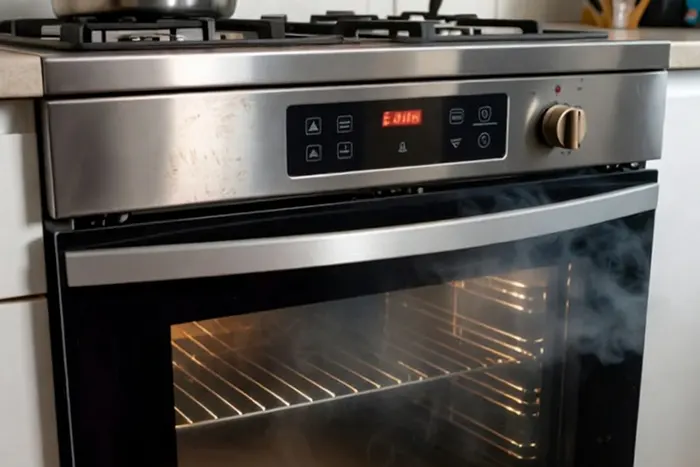
- Burning smell. Indicates melting insulation or overheating – fire risk.
- Sparks. Visible flashes inside – sign of short circuit, unplug the oven immediately.
- The oven stops responding completely. No response on the panel – issue with power or board.
- Breaker trips when turning on. Repeated tripping – sign of serious wiring fault.
Why Choose Prime Appliance Repair
Repair on the Day of Your Call
We handle most jobs the same day you call. You don't have to wait weeks – get back to your routine without downtime.
Original Parts and Manufacturer Standards
We use only certified parts from official suppliers and strictly follow brand instructions. Repairs are more effective than with generic parts – no repeat breakdowns.
90-Day Warranty on Everything
Warranty covers labor and parts: if something goes wrong, we'll fix it for free.
Technician Arrives Within an Hour
The tech will reach any point in the city within an hour. We value your time, so we solve issues quickly without disrupting your schedule.
We'll fix the problem fast, and you'll be cooking with stable heat again.
Contact us
